How to save on construction materials in Quebec: 7 contractor methods
Compare prices across retailers, check your sales rep's price, avoid losses and repeat purchases on site: 7 ways to pay less for your materials.
- Author
- Allokit
- Published
- Reading time
- 7 min
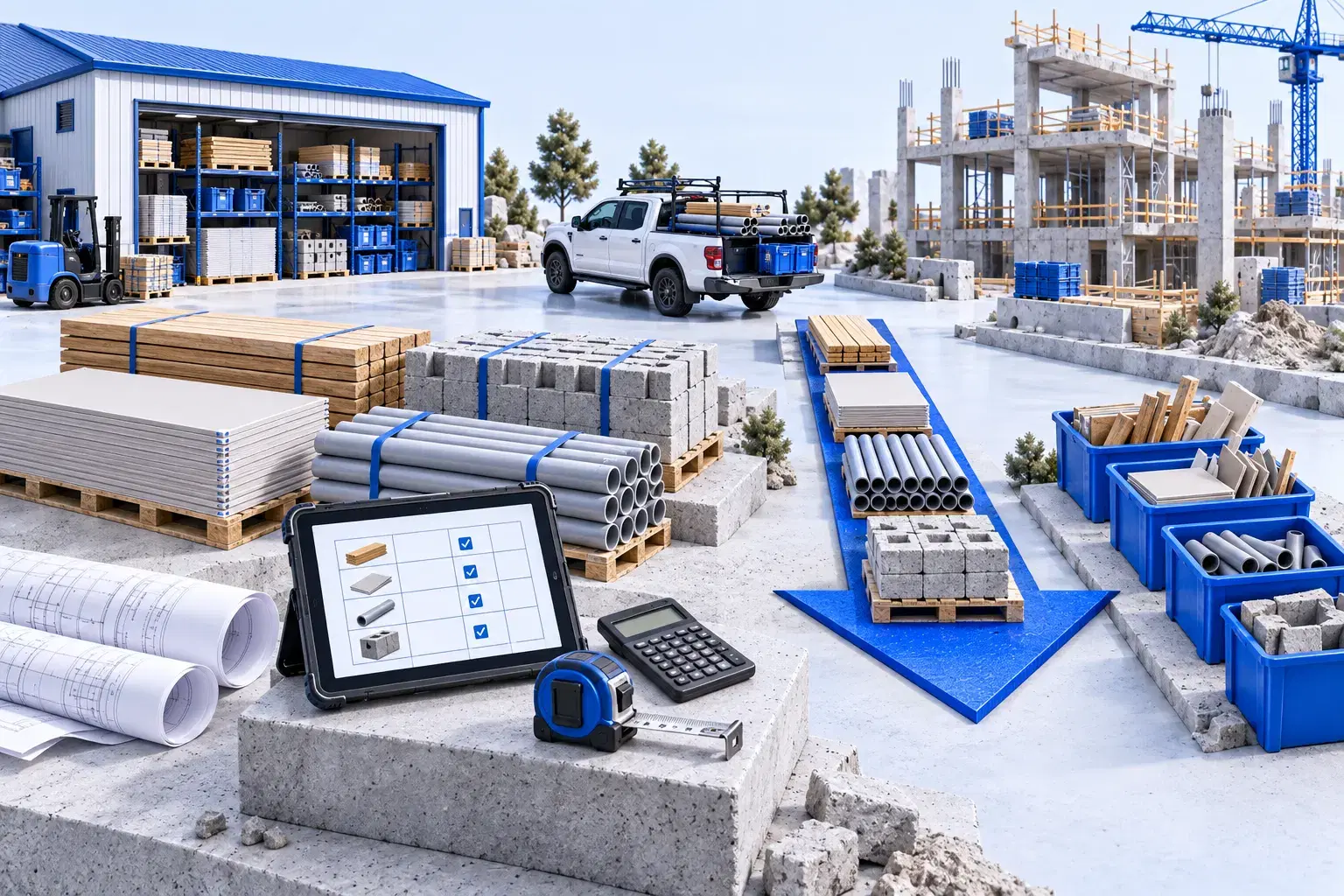
To pay less for construction materials, compare prices across retailers before every large order, check the price your sales rep gives you, and reduce what gets lost between delivery and installation. The purchase price is only half the equation: a material that is stolen, damaged or bought twice costs twice.
Here are seven methods, from the quote to the jobsite.
1. Compare prices before every large order
The same basket of materials does not cost the same from one retailer to the next. The problem is that comparing a 60-item list across four stores takes hours.
That is what Bâtir à Rabais does, a Quebec company based in Sainte-Julienne. You submit a materials list as text, a photo, an Excel file or a PDF. The platform compares prices across Quebec retailers and suggests the cheapest purchasing plan, in a single store or split across several.
A few details from its website, checked in September 2026:
- The comparison covers 32 partner retailers, among hundreds of stores in Quebec.
- The free plan allows 5 comparisons and 5 assistant messages per month, with no credit card.
- Paid plans add photo, Excel and PDF import, retailer selection and applied contractor discounts.
- The company was founded by Alexandre Pelletier, an electrician and real estate investor, and Simon Lafortune.
Its co-founder discussed it on Radio-Canada. Allokit is not affiliated with Bâtir à Rabais; we mention it because it is a Quebec tool built for this exact problem.
2. Check your sales rep's price
A contractor who always buys from the same place often gets a negotiated price. It is still worth checking from time to time. Bâtir à Rabais actually pitches this to contractors: check a rep's price in a few seconds.
The goal is not to switch suppliers with every order. A good relationship is worth something: reliable deliveries, credit, easy returns. But a comparison with numbers gives you a concrete argument for the next negotiation.
3. Ask for written quotes on large projects
For a major project, ask two or three suppliers for written quotes, with the same quantities and the same specifications. Also ask how long the price is valid. On a jobsite that runs for months, a guaranteed price protects you against increases.
4. Order at the right time, not too early
Materials delivered too early wait on the jobsite. They get rained on, crushed by machinery or disappear. The APCHQ points out that ten or so sheets of plywood are enough to attract a thief.
Have materials delivered in phases, as close to installation as possible. That is even more true before the construction holiday, when jobsites sit empty for two weeks.
5. Track leftovers from one jobsite to the next
Every jobsite leaves leftovers: boxes of screws, rolls of membrane, pipe offcuts, cutting discs. If nobody records them, they sleep at the back of a trailer while the other crew buys more at the store.
A simple inventory is enough to start: what is left, how much, and where it is stored. Before each order, check what you already have. A shared spreadsheet works at first, as long as someone updates it at the end of each jobsite.
6. Stop buying tools you already own
The same reasoning applies to tools. A tool nobody can find on a Monday morning often becomes a tool bought again in a hurry, at full price, at the nearest store. The original shows up three weeks later in another truck.
To know who has what and on which jobsite, see our guide to construction asset tracking. To put a number on these repurchases, read how to reduce equipment costs.
7. Count the time spent picking up materials
A round trip to the store for a forgotten item costs more than the item. In 2026, a carpenter-joiner in the institutional-commercial sector costs the employer $84.64 an hour, according to the ACQ grid. An hour on the road for a box of screws therefore costs more than $80 in labour, before counting the truck. The breakdown by trade is in our guide to 2026 CCQ hourly rates.
A complete materials list, checked against inventory before ordering, cuts down on these trips.
In short
| Method | What it reduces |
|---|---|
| Compare prices across retailers | The price paid |
| Check your rep's price | The price paid |
| Written quotes with a guaranteed price | The risk of increases |
| Phased deliveries | Losses, theft, damage |
| Inventory of leftovers | Duplicate purchases |
| Tool tracking | Emergency repurchases |
| List checked before ordering | Trips to the store |
The first three methods happen before the purchase. The other four happen once the materials are delivered. For tools, machinery and vehicles, that is where Allokit can help: see how tracking works or let's talk about your jobsites.